Letter to the Editor: Australia’s first detection of HPAI H5N1 in a wild bird: a regional sentinel for Indonesia’s One Health preparedness
Infectious Diseases and Tropical Medicine 2026;
12
: e1881
DOI: 10.32113/idtm_202609_1881
Topic: Viral Infection
Category: Letter to the Editor
To the Editor,
On 20 June 2026, Australia notified the World Organization for Animal Health of its first confirmed detection of highly pathogenic avian influenza (HPAI) H5N1 in a wild bird: a migratory brown skua (Stercorarius antarcticus) found near Cape Le Grand National Park, Western Australia. The virus was identified as H5N1 clade 2.3.4.4b, and its genomic sequence is available in the Global Initiative on Sharing All Influenza Data (GISAID) database (https://gisaid.org) under isolate ID EPI_ISL_20479340 (A/Brown Skua/Western Australia/AS-26-1348-1/2026). By 13 July 2026, Australian authorities had reported 13 H5 detections in individual wild seabirds: seven in Western Australia, five in South Australia, and one in New South Wales. All but one involved migratory seabirds; a greater crested tern detected near Robe, South Australia, represented the first confirmed H5 detection in a non-migratory Australian seabird. No mass mortality events, poultry infections, or broader agricultural involvement had been reported, and the public health risk remained low1-3. Given the regional significance of HPAI H5N1 and Indonesia’s proximity to Australia, these developments also warrant consideration in the context of Indonesia’s One Health preparedness.
These findings should not be interpreted as evidence of a direct Australia-to-Indonesia transmission pathway.
Rather, they provide a regional sentinel signal that HPAI H5N1 clade 2.3.4.4b has reached wildlife in a subregion that had previously remained free of this subtype. Notably, targeted surveillance conducted before the first mainland detection found no HPAI H5N1 in 924 avian samples or 38 Australian sea lions, highlighting both the value and the limitations of active surveillance for detecting sporadic incursions into wildlife populations4. Earlier assessments also identified important knowledge gaps regarding long-distance seabird movements, potential Southern Ocean introduction pathways, and surveillance of remote wildlife populations5.
Globally, HPAI H5N1 clade 2.3.4.4b has fundamentally altered the epidemiology of avian influenza. Unlike earlier poultry-associated H5N1 outbreaks, the current panzootic is characterized by an expanded host range, with repeated detections in wild birds, poultry, marine mammals, and terrestrial mammals. The latest joint FAO–WHO–WOAH assessment continues to classify the risk to the general population as low while emphasizing an elevated risk for occupationally and frequently exposed individuals6. Accordingly, Indonesia’s response should be proportionate and evidence-based – not through alarm or unsupported trade restrictions, but by strengthening surveillance at the wildlife–poultry–human interface.
Indonesia possesses important foundations for H5N1 preparedness; however, several vulnerabilities remain. Human health authorities already conduct influenza-like illness (ILI) and severe acute respiratory infection (SARI) surveillance that incorporates information on exposure to sick or suddenly dead poultry and contaminated environments7. A district-level multisectoral One Health joint risk assessment has also been implemented in Bogor8. Accordingly, the priority should be to expand geographic coverage, standardize wildlife and live bird market surveillance, accelerate genomic sequencing turnaround, and improve interoperability across human, animal, and environmental surveillance systems, rather than establish entirely new preparedness structures. A recent Indonesian review9 similarly identified inconsistent biosecurity practices in live bird markets, limited routine genomic surveillance of poultry and wild birds, gaps in laboratory access and capacity, and fragmented intersectoral data sharing as persistent priorities for improvement.
Distinguishing endemic circulation from new viral introductions is essential for accurate epidemiological interpretation. Indonesia has experienced long-standing circulation of HPAI H5N1 in poultry, and clade 2.3.4.4b is not merely a hypothetical future introduction. Viruses belonging to this clade were isolated from domestic ducks during outbreaks in South Kalimantan in April 2022 and July 2023 and were genetically most closely related to viruses detected in East Asia. However, the exact route of introduction could not be determined10. Consequently, future H5 detections in Indonesia may reflect continued circulation of established viruses, additional introductions of genetically distinct clade 2.3.4.4b viruses, or reassortant viruses arising during co-circulation. Genomic characterization is essential to distinguish among these epidemiological scenarios.
Rather than designating entire provinces as uniformly high risk, Indonesia should prioritize surveillance according to documented epidemiological pathways. Selected pathway-specific settings and their supporting evidence are summarized in Table 1. The geographical labels correspond to the specific sites, sampled markets, outbreak settings, or administrative areas described in the cited sources and should not be interpreted as representing uniform risk across the surrounding provinces. Figure 1 complements this evidence-based framework by integrating the Australian HPAI H5N1 detection as a regional sentinel signal with selected pathway-specific surveillance settings in Indonesia and five complementary priorities for strengthening One Health preparedness.
Table 1. Selected pathway-specific settings to strengthen H5N1 surveillance in Indonesia.
| Priority setting | Pathway and supporting evidence | Surveillance focus |
| Kupang Bay, East Nusa Tenggara | Ecological sentinel: an internationally important wetland supporting 2,000-5,500 shorebirds and a unique assemblage of Asian, Australian, and cosmopolitan waterbirds. This ecological connectivity does not demonstrate directional H5N1 transmission from Australia to Indonesia11,12. | Migratory waterbirds, unusual bird mortality, wetland environments, and nearby poultry populations. |
| Domestic duck outbreak settings in South Kalimantan | Confirmed HPAI H5N1 clade 2.3.4.4b infections in domestic ducks during 2022-2023, with affected farms associated with nearby marsh environments10. | Domestic ducks, farm-to-market poultry movements, marsh interfaces, and whole-genome sequencing. |
| Selected live bird markets in Banten, Jakarta, West Java, Central Java, and East Java | Market-associated maintenance and amplification: H5N1 was detected in poultry and environmental samples collected from selected live bird markets in Banten, Jakarta, West Java, Central Java, and East Java during 2014-2019, including viruses belonging to clades 2.1.3 and 2.3.2 and several reassortant lineages. More recent surveillance in selected markets in Surabaya, Sidoarjo, Pasuruan, and Malang also identified H5-positive poultry samples, including an H5N1 clade 2.3.2.1c virus isolated from an apparently healthy chicken13-15. | Repeated poultry and environmental sampling, source tracing, genomic sequencing, surveillance of apparently healthy birds, sanitation, and market biosecurity. |
| Bogor, West Java | District-level One Health joint risk assessment setting: influenza A virus was detected in two environmental samples, but no H5 subtype was identified. The likelihood of at least one locally acquired human infection was assessed as low, with moderate uncertainty8. | Joint risk assessment, integrated waste management, poultry-movement monitoring, occupational health surveillance, and multisectoral information sharing. |
| Duck-farming systems in Sidenreng Rappang Regency, South Sulawesi | HPAI H5N1 clade 2.3.2.1c was identified in clinically affected ducks during an outbreak in Sidenreng Rappang Regency, South Sulawesi in 201816. | Investigation of neurological signs and sudden duck mortality, with farm and environmental water sampling, poultry movement tracing, and genomic characterization. |
As illustrated in Figure 1, the Australian HPAI H5N1 detection should be interpreted as a regional sentinel signal rather than evidence of a source-specific threat to Indonesia. The selected Indonesian settings represent distinct but complementary surveillance pathways, including ecological surveillance in Kupang Bay, East Nusa Tenggara, documented domestic duck outbreaks involving different H5N1 clades in South Kalimantan and South Sulawesi, multisite live bird market surveillance in selected parts of Java, and district-level One Health joint risk assessment in West Java.
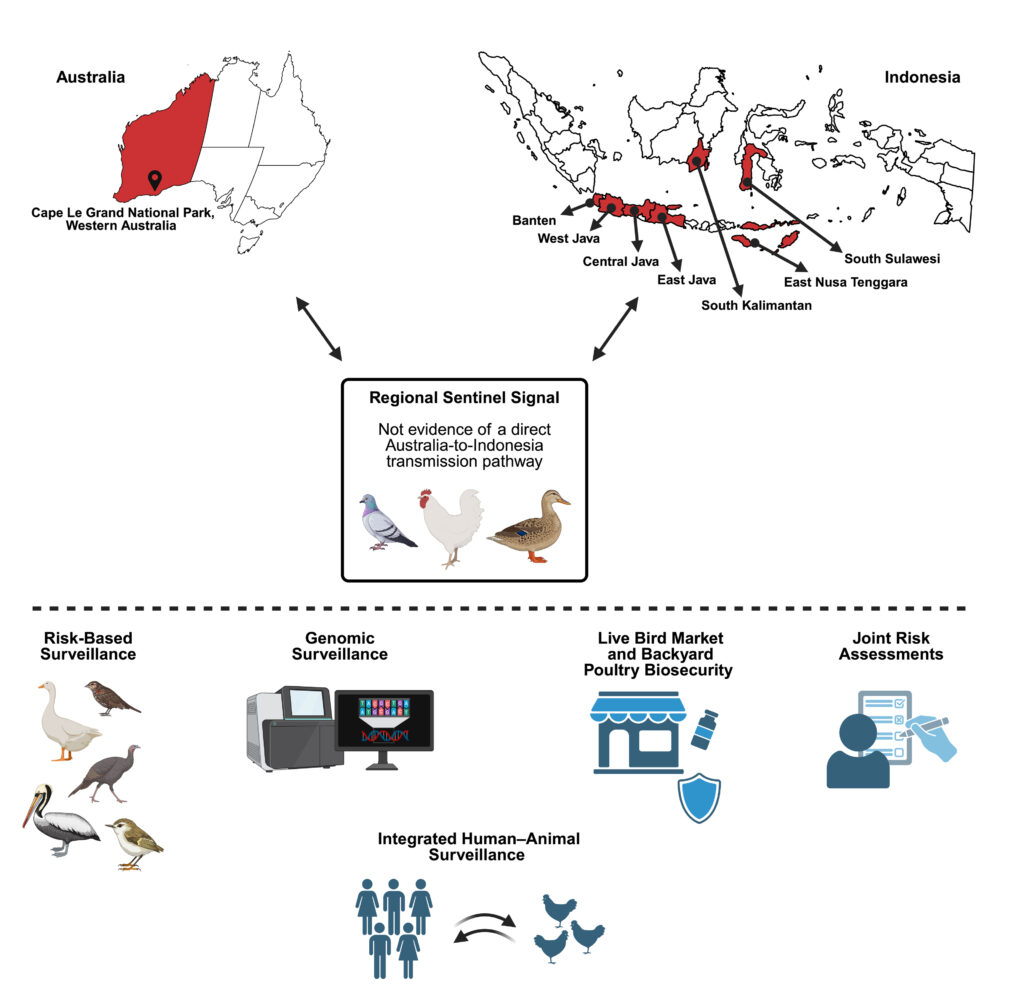
Figure 1. Schematic conceptual framework presenting Australia’s HPAI H5N1 wild-bird detection as a regional sentinel signal, selected pathway-specific surveillance settings in Indonesia, and five complementary priorities for strengthening Indonesia’s One Health preparedness. Geographical labels in the figure are presented schematically; the precise evidence-based setting names and geographical scopes are provided in Table 1. The figure does not depict a demonstrated direction of H5N1 transmission from Australia to Indonesia and does not represent a formal ranking or systematic prioritization of provincial H5N1 risk. Created with BioRender.com under a valid publication license.
Together, Table 1 and Figure 1 illustrate that surveillance and preparedness strategies should be tailored to the underlying epidemiological pathways rather than applied uniformly across provinces. The recent H5N1 detection in Australia therefore provides an opportunity for Indonesia to shift from reactive outbreak response to proactive risk management by strengthening the five complementary domains outlined in Figure 1. First, risk-based surveillance should be expanded using transparent prioritization criteria, including documented wild bird connectivity, previous H5 detections, poultry density and movement, live bird market activity, existing surveillance gaps, and laboratory diagnostic capacity.
Passive reporting of unusual wild bird mortality should be integrated with targeted surveillance of seabirds, shorebirds, domestic ducks, backyard chickens, and shared environments. Second, existing genomic surveillance systems should be standardized and strengthened to ensure that H5-positive samples are rapidly sequenced, compared with Indonesian and regional reference genomes, and shared through appropriate data-sharing platforms. Cross-border genomic surveillance and data exchange with Australia, Timor-Leste, Papua New Guinea, and regional surveillance networks should be enhanced while avoiding any implication that a particular country is the source of a potential H5N1 introduction.
Third, live bird markets and backyard poultry systems should be prioritized for practical and enforceable interventions. This priority is consistent with broader evidence that migratory waterfowl, backyard and commercial poultry, live bird markets, and abattoirs represent multiple epidemiological interfaces requiring coordinated surveillance and strengthened biosecurity measures17. Recommended interventions include routine cleaning and disinfection, separation of ducks and chickens, avoidance of mixed-species cages, safe management of slaughter waste, exclusion of visibly sick birds from sale, regular disinfection of transport cages and vehicles, and improved access to handwashing facilities and personal protective equipment13,14,17. Reporting systems should seek to minimize economic disincentives without assuming that concealment of poultry mortality is universal. Fourth, human health surveillance should be closely integrated with signals from animal health surveillance. Influenza-like illness (ILI) and SARI surveillance systems should consistently document occupational and environmental exposures among poultry traders, slaughterhouse workers, cullers, veterinarians, wildlife responders, and household contacts of suspected or confirmed cases.
Fifth, Indonesia should institutionalize district-level One Health joint risk assessments by strengthening and expanding existing local initiatives rather than establishing new systems. The Bogor assessment illustrated how live bird markets can be evaluated as local human–animal–environment interfaces: two environmental samples tested positive for influenza A virus, no H5 subtype or locally acquired human case was detected, and the estimated likelihood of at least one human infection remained low, albeit with moderate uncertainty8. Its primary value lies in identifying potential local transmission pathways and informing feasible control measures, rather than demonstrating ongoing H5N1 circulation.
Australia’s first detection of H5N1 in a wild bird does not indicate that Indonesia is facing an imminent human epidemic, nor does it establish a direct route of viral spread. Nevertheless, it reinforces the need to strengthen Indonesia’s existing One Health framework while differentiating between endemic circulation, new viral introductions, and reassortment events. An appropriate response is to enhance integrated surveillance across wildlife, poultry, live bird markets, genomic monitoring, and occupationally exposed populations to reduce the probability and consequences of future spillover events. The epidemiological information presented in this Letter was reviewed and updated on 13 July 2026.
Conflict of Interest
The authors declare that they have no conflict of interest.
Ethics Approval
Not applicable.
Informed Consent
Not applicable.
Data Availability
Data sharing is not applicable to this article because no original datasets were generated or analyzed.
Authors’ Contributions
MRA and ANMA conceived the study, developed the conceptual framework, and contributed to the preparation of the manuscript. MRA drafted the original manuscript. ANMA critically reviewed and revised the manuscript for important intellectual content. Both authors read and approved the final version of the manuscript and agree to be accountable for all aspects of the work.
ORCID ID
Moh. Royhan Afnani: 0009-0002-8517-7069
Arif Nur Muhammad Ansori: 0000-0002-1279-3904
Funding
The preparation of this Letter was supported by the Virtual Research Center for Bioinformatics and Biotechnology, Surabaya, Indonesia (https://jalantengah.site/vrcbb/) [Grant No. RG/26/06/10].
AI Disclosure
Grammarly was used solely for English-language proofreading, grammar correction, and sentence-level refinement to improve the scientific writing style of the manuscript. ChatGPT (OpenAI) was used only as a brainstorming aid to discuss the conceptual organization of Figure 1. Figure 1 and all of its graphical elements were independently prepared and assembled by the authors using BioRender.com. All scientific statements, references, geographical labels, and graphical elements were independently checked, critically revised, and approved by the authors. The authors take full responsibility for the accuracy, originality, integrity, and final content of the manuscript and Figure 1.
References
- Australian Government Department of Agriculture, Fisheries and Forestry. Bird flu (avian influenza). Canberra: Australian Government; 2026. Available from: https://www.agriculture.gov.au/campaigns/birdflu (accessed July 14, 2026).
- World Organization for Animal Health. Australia notifies first case of high pathogenicity avian influenza H5N1 in a wild bird. Paris: WOAH; 2026. Available from: https://www.woah.org/en/australia-notifies-first-case-of-high-pathogenicity-avian-influenza-h5n1-in-a-wild-bird/ (accessed July 14, 2026).
- Australian Government Department of Agriculture, Fisheries and Forestry. H5 bird flu testing updates. Canberra: Australian Government; 2026. Available from: https://www.agriculture.gov.au/about/news/H5-testing-updates (accessed July 14, 2026).
- Wille M, Ross TA, Atkinson R, Boyle DB, Christie M, Dewar ML, Douglas TK, Gray R, Hansen B, Jessop R, Kidd LR, Marks I, Mileto P, Miller E, Neave MJ, Ryding S, Sutherland DR, Yu H, Klaassen M. Migratory bird and marine mammal surveillance fails to find evidence for an HPAI H5N1 2.3.4.4b incursion into Australia in 2025. Influenza Other Respi Viruses 2026; 20: e70281.
- Zhang P, MacIntyre CR. An overview of HPAI H5N1 clade 2.3.4.4b and its emerging threat in mainland Australia: identified knowledge gaps. One Health 2026; 22: 101292.
- Food and Agriculture Organization of the United Nations, World Health Organization, World Organization for Animal Health. Updated joint FAO/WHO/WOAH public health assessment of recent high pathogenicity avian influenza A(H5) virus events in animals and people: assessment based on data as of 1 March 2026. Rome, Geneva, Paris: FAO, WHO, WOAH; 2026. Available from: https://www.woah.org/app/uploads/2026/05/2026-05-18-fao-woah-who-h5-assessment.pdf (accessed July 14, 2026).
- Ministry of Health of the Republic of Indonesia. Tetap waspada risiko penularan flu burung pada manusia. Jakarta: Ministry of Health of the Republic of Indonesia; 2024. Available from: https://kemkes.go.id/id/tetap-waspada-risiko-penularan-flu-burung-pada-manusia (accessed July 14, 2026).
- Sudarnika E, Pisestyani H, Idris S, Setiaji G, Iryawati D, Hardianti N, Mayasari NLPI, Poetri ON, Basri C, Ridwan Y, Agungpriyono S. District-level joint risk assessment of highly pathogenic avian influenza H5N1 at the human-animal-environment interface in live bird markets of Bogor, Indonesia. Vet World 2026; 19: 210-223.
- Ewaldo MF, Dewi BE, Kartika AAA, Faridah AT, Nelwan EJ, Erlina L, Yasmon A, Karuniawati A. Avian influenza in Indonesia: a literature review on epidemiology, viral evolution, and public health implications. Microbes Infect Dis 2026; 7: 35-44.
- Wibawa H, Wibowo PE, Supriyadi A, Lestari, Silaban J, Fuadi AA, Fiqri AJ, Handayani RW, Irianingsih SH, Fahmia Z, Mulyawan H, Idris S, Zainuddin N. Highly pathogenic avian influenza A(H5N1) virus clade 2.3.4.4b in domestic ducks, Indonesia, 2022. Emerg Infect Dis 2024; 30: 586-590.
- McCallum HI, Roshier DA, Tracey JP, Joseph L, Heinsohn R. Will Wallace’s Line save Australia from avian influenza? Ecol Soc 2008; 13: 41.
- Trainor CR, Hidayat O. Kupang Bay: an internationally significant wetland in West Timor, Indonesia. BirdingASIA 2014; 21: 45-50.
- Dharmayanti NLPI, Hewajuli DA, Ratnawati A, Hartawan R. Genetic diversity of the H5N1 viruses in live bird markets, Indonesia. J Vet Sci 2020; 21: e56.
- Rehman S, Effendi MH, Shehzad A, Rahman A, Rahmahani J, Witaningrum AM, Bilal M. Prevalence and associated risk factors of avian influenza A virus subtypes H5N1 and H9N2 in live bird markets of East Java Province, Indonesia: a cross-sectional study. PeerJ 2022; 10: e14095.
- Rehman S, Prasetya RR, Rahardjo K, Effendi MH, Rantam FA, Rahmahani J, Witaningrum AM, Nastri AM, Dewantari JR, Mori Y, Shimizu K. Whole-genome sequence and genesis of an avian influenza virus H5N1 isolated from a healthy chicken in a live bird market in Indonesia: accumulation of mammalian adaptation markers in avian hosts. PeerJ 2023; 11: e14917.
- Mutisari D, Muflihanah M, Wibawa H, Hendrawati F, Putra HH, Sulistyo KP, Ahmad A, Sjahril R, Mubin RH, Sari DK, Massi MN. Phylogenetic analysis of HPAI H5N1 virus from duck swab specimens in Indonesia. J Adv Vet Anim Res 2021; 8: 346-354.
- Rehman S, Ullah S, Effendi MH, Budiastuti B, Hamid IS, Rahman AU, Zaman A, Malik MIU, Rustam SA, Ullah S, Saleem Z. Avian influenza virus H5N1 and H9N2 subtypes in different birds and humans: findings from an extensive evaluation. Open Vet J 2026; 16: 1-14.
To cite this article
Letter to the Editor: Australia’s first detection of HPAI H5N1 in a wild bird: a regional sentinel for Indonesia’s One Health preparedness
Infectious Diseases and Tropical Medicine 2026;
12
: e1881
DOI: 10.32113/idtm_202609_1881
Publication History
Submission date: 28 Jun 2026
Revised on: 13 Jul 2026
Accepted on: 26 Aug 2026
Published online: 03 Sep 2026

This work is licensed under a Creative Commons Attribution-NonCommercial-ShareAlike 4.0 International License.