Measles resurgence in Indonesia in 2026: post-pandemic immunity gaps and emerging public health challenges
Infectious Diseases and Tropical Medicine 2026;
12
: e1828
DOI: 10.32113/idtm_202604_1828
Topic: Viral Infection
Category: Letter to the Editor
Dear Editor,
The resurgence of measles in Indonesia during the first quarter of 2026 represents a significant public health concern that may warrant increased attention and reassessment of broader public health preparedness1. Data from the Ministry of Health of the Republic of Indonesia indicate that, from the first week through the twelfth week (end of March) of 2026, measles outbreaks have been reported across multiple regions, affecting at least 14 provinces nationwide (Figure 1). During this period, suspected measles cases were reported, many of which were laboratory confirmed, as shown in Table 12. For a disease that is fully preventable through effective vaccination, these figures represent a substantial regression in progress toward measles–rubella elimination3, which may reflect gaps in population immunity and vaccination coverage. Notably, the Ministry of Health of the Republic of Indonesia2 has also reported a substantial decline in both suspected and confirmed measles cases over this period, with daily reported cases decreasing by approximately 93%, from a peak of 2,220 cases in the first week to 146 cases by mid-March 2026. This trend may suggest the impact of ongoing public health responses, although continued monitoring remains essential2.
The epidemiological pattern of the outbreak is consistent with a potential widening immunity gap in the post-pandemic period. In 2025, the Ministry of Health of the Republic of Indonesia reported 11,094 confirmed measles cases, alongside 63,769 suspected cases, representing a 147% increase compared to 2024, and 69 associated deaths. Infants under one year of age, most of whom had not yet received immunization, accounted for the highest proportion of cases (68%). These figures suggest that Indonesia may be among the countries with a relatively high global measles burden, although direct comparisons require standardized international data. Disruptions to routine immunization services, compounded by persistent vaccine hesitancy since the COVID-19 pandemic, may have contributed to a substantial number of children missing their scheduled measles–rubella vaccinations. This hesitancy may represent an important contributing factor to declining vaccination coverage, further expanding the pool of susceptible individuals. Consequently, the increasing number of zero-dose and under-immunized children may create conditions conducive to sustained transmission of the measles virus, one of the most highly contagious pathogens in humans4-6.
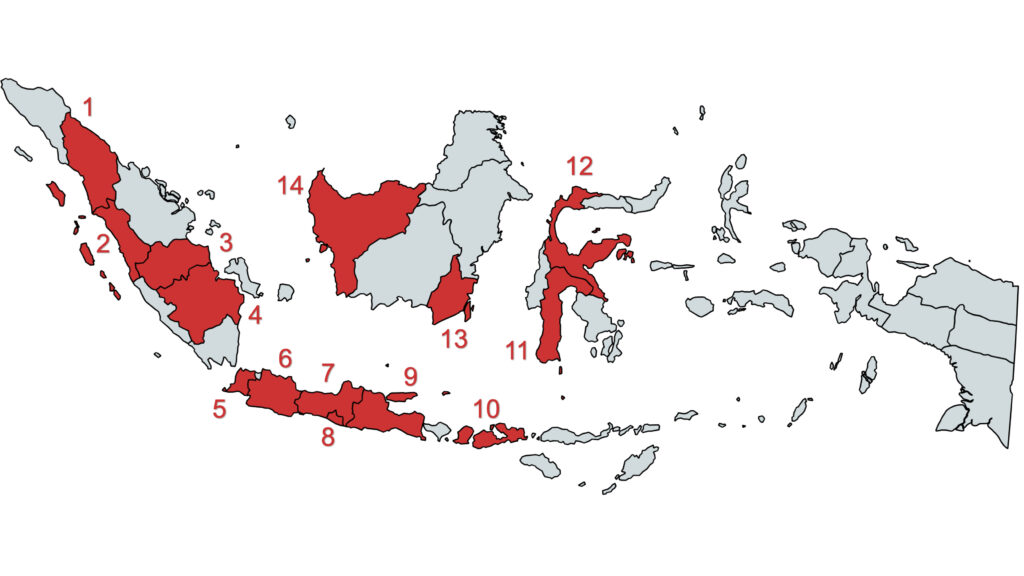
Figure 1. Schematic geographic distribution of provinces with reported measles cases across selected provinces in Indonesia, including (1) North Sumatra, (2) West Sumatra, (3) Jambi, (4) South Sumatra, (5) Banten, (6) West Java, (7) Central Java, (8) Special Region of Yogyakarta, (9) East Java, (10) West Nusa Tenggara, (11) South Sulawesi, (12) Central Sulawesi, (13) South Kalimantan, and (14) West Kalimantan based on surveillance data from the Ministry of Health of the Republic of Indonesia in 2026 (as of the end of March 2026). The map was generated using MapChart (https://www.mapchart.net).
Table 1. Distribution of suspected measles cases and confirmed measles cases by reporting week during the observation period, based on surveillance data from the Ministry of Health of the Republic of Indonesia in 2026 (as of the end of March 2026). The data illustrate the temporal trend of measles cases from week 1 to week 12, highlighting variations in suspected and confirmed cases that may reflect transmission dynamics and surveillance response.
| Week | Suspected measles cases | Measles cases |
| Week 1 | 2,932 | 2,220 |
| Week 2 | 2,040 | 1,570 |
| Week 3 | 2,139 | 1,650 |
| Week 4 | 2,144 | 1,585 |
| Week 5 | 1,975 | 1,492 |
| Week 6 | 1,826 | 1,447 |
| Week 7 | 1,756 | 1,377 |
| Week 8 | 1,756 | 1,392 |
| Week 9 | 2,094 | 1,664 |
| Week 10 | 1,787 | 1,379 |
| Week 11 | 481 | 368 |
| Week 12 | 211 | 146 |
Vaccination status data indicate a substantial immunity gap, reflected in the predominance of measles cases among unvaccinated individuals during the 2025-2026 period, highlighting persistent inequities in access to immunization services. Despite Indonesia’s well-established primary healthcare system through the Puskesmas (Primary Health Care Center) network, the outbreak may highlight potential weaknesses in local implementation, particularly in affected areas (Figure 1), where geographic barriers, limited healthcare access, and sociocultural factors may continue to hinder vaccine uptake. This pattern is further illustrated by an outbreak investigation in Brondong Subdistrict, Lamongan District, East Java, Indonesia, in 2023, which demonstrated a propagated outbreak characterized by person-to-person transmission within the community. In that setting, low immunization coverage, especially for the second dose, appeared to be a major contributing factor to a growing susceptible population. This gap may have been influenced by vaccine hesitancy and high dropout rates associated with the long interval between doses, with post-pandemic disruptions acting as an additional contributing factor, collectively increasing the risk of transmission and facilitating outbreak occurrence5-9.
From both virological and clinical perspectives, effective outbreak control requires the integration of molecular surveillance into routine public health practice to better characterize transmission dynamics. Measles is a highly contagious, vaccine-preventable disease caused by an enveloped virus of the family Paramyxoviridae, genus Morbillivirus, with current vaccines providing protection against all known circulating strains. In Indonesia, multiple genotypes, including G2, G3, D8, and D9, have been reported, while in Southeast Asia, B3 and D8 predominate and require continuous monitoring. In addition, whole-genome sequencing may help distinguish endemic transmission from potential introductions, while advanced diagnostics such as digital PCR may enhance detection sensitivity. Integrating these data into digital health platforms could support real-time epidemiological analysis and more targeted public health responses10-12.
Addressing vaccine hesitancy is likely to remain an important challenge, particularly in affected regions where it is driven by sociocultural, religious, and informational factors, and where conventional top-down communication strategies may be insufficient in some settings. Effective responses should prioritize targeted community engagement involving local leaders, religious authorities, educators, and community health workers, supported by transparent communication on vaccine safety and the risks of measles complications to counter misinformation and rebuild public trust. These challenges, taken together, may be consistent with the concept of “immunity debt” following the COVID-19 pandemic, characterized by an expanded pool of susceptible individuals and an increased risk of vaccine-preventable disease outbreaks3,5,6,8,13,14. Addressing this requires sustained health system strengthening, including restoration of immunization services, enhancement of surveillance systems, and reinforcement of healthcare workforce capacity to mitigate the long-term impacts of disruptions to essential health services.
In conclusion, the measles resurgence in Indonesia in 2026 represents a potential setback that may be associated with immunity gaps, inequities in healthcare access, and post-pandemic effects. Effective control is likely to require prioritizing expanded outbreak response immunization targeting missed cohorts, alongside full restoration of routine immunization services using a no-missed-opportunity approach. In parallel, culturally appropriate risk communication strategies are essential to address vaccine hesitancy through community engagement and transparent messaging. Surveillance systems could be strengthened through the integration of molecular epidemiology and real-time digital platforms to support early detection and rapid response. Sustained political commitment and targeted investment will be critical to restore immunization coverage, reduce transmission, and realign progress toward measles and rubella elimination goals.
Ethics Approval:
Not applicable.
Informed Consent:
Not applicable.
Funding:
This study was supported by the Virtual Research Center for Bioinformatics and Biotechnology (VRCBB), Surabaya, Indonesia (https://jalantengah.site/vrcbb/) [Grant No. RG/26/03/07].
Conflict of Interest:
The author declares no conflict of interest.
References
- Setiawaty V, Hapsari R, Kelyombar C, Anisiska D, Subangkit S, Mursinah M, Mardin N, Rusipah R. Indonesia measles immunization program monitoring: An analysis of 5 years measles surveillance data. Tanzan J Health Res 2024; 25: 1370.
- Ministry of Health of the Republic of Indonesia. Protect Medical and Healthcare Workers, Ministry of Health Issues Circular on Measles Alert. 2026. Available at: https://kemkes.go.id/id/lindungi-tenaga-medis-dan-tenaga-kesehatan-kemenkes-keluarkan-surat-edaran-kewaspadaan-campak. Accessed April 8, 2026.
- Murphy AA, Indah R, Yufika A, Ichsan I, Liansyah TM, Harapan H, Birchok D, Pogue JM, Khairadini F, Wagner AL. Understanding the influence of religious and safety concerns on childhood measles and pertussis vaccination: A study conducted in Aceh, Indonesia, 2022. BMC Infect Dis 2025; 25: 1140.
- Centers for Disease Control and Prevention (CDC). Global Measles Outbreaks. 2026. Available at: https://www.cdc.gov/global-measles-vaccination/data-research/global-measles-outbreaks/index.html. Accessed March 20, 2026.
- Ministry of Health of the Republic of Indonesia. Kemenkes Waspadai Dinamika Campak Nasional dan Global. 2026. Available at: https://www.kemkes.go.id/id/kemenkes-waspadai-dinamika-campak-nasional-dan-global. Accessed March 20, 2026.
- Romadhon D. “It was tidak cocok (incompatible)”: Incompatibility, Decoloniality, and Vaccine Hesitancy in Banda Aceh, Indonesia. Med Anthropol Q 2025; e70024.
- Biothreats Emergence, Analysis and Communications Network (BEACON). Ongoing measles transmission in Indonesia despite immunization campaigns. 2026. Available at: https://beaconbio.org/en/report/?reportid=88d14786-3995-4565-b561-23dd6a1554d4&eventid=8ac18dc0-44b5-4eda-9587-4d5e45f99767. Accessed March 20, 2026.
- Ua K, Hendrati LY, Son KL, Sari SSN, Astutik E, Sigunawan. Investigation of a measles outbreak in Brondong subdistrict, Lamongan district, Indonesia, 2023. West Pac Surveill Response J 2025; 16: 43.
- Sylvia G, Sitaresmi MN, Aryanto S, Wiratama BS. Evaluation of measles–rubella control and prevention program implementation: system and community review. Clin Epidemiol Glob Health 2024; 29: 101758.
- Rota PA, Brown K, Mankertz A, Santibanez S, Shulga S, Muller CP, Hübschen JM, Siqueira M, Beirnes J, Ahmed H, Triki H, Al-Busaidy S, Dosseh A, Byabamazima C, Smit S, Akoua-Koffi C, Bwogi J, Bukenya H, Wairagkar N, Ramamurty N, Incomserb P, Pattamadilok S, Jee Y, Lim W, Xu W, Komase K, Takeda M, Tran T, Castillo-Solorzano C, Chenoweth P, Brown D, Mulders MN, Bellini WJ, Featherstone D. Global distribution of measles genotypes and measles molecular epidemiology. J Infect Dis 2011; 204(Suppl 1): S514.
- Hartoyo E, Wiyatno A, Jaya UA, Ma’roef CN, Monagin C, Myint KS, Safari D. Occurrence of measles genotype D8 during a 2014 outbreak in Banjarmasin, South Kalimantan, Indonesia. Int J Infect Dis 2017; 54: 1.
- Ansori ANM, Kharishma VD, Muttaqin SS, Antonius Y, Parikesit AA. Genetic variant of SARS-CoV-2 isolates in Indonesia: spike glycoprotein gene. J Pure Appl Microbiol 2020; 14(suppl 1): 971.
- Stona AC, Khoo YK, Moe L, Wulandari S, Agoramurthy S, Getchell M, Mak TM, Pang J, Liu EJ, Selva Kumar S, Lim JC, Smith GJD, Bertholet A, Garg A, Harsono S, Magner M, Qadri F, Shirin T, Andalucia LR, Munira SL, Xangsayarath P, Robinson MT, Setk S, Myat Tu H, Arunkumar G, Jha R, Amir A, Ikram A, Nisar I, Dizon T, Saloma C, Malavige NG, De Alwis R, Pronyk PM. Strengthening supply chains for pathogen genomic surveillance in Asia. BMJ Glob Health 2026; 11: e019241.
- Cahyani I, Putro EW, Ridwanuloh AM, Wibowo S, Hariyatun H, Syahputra G, Akbariani G, Utomo AR, Ilyas M, Loose M, Kusharyoto W, Susanti S. Genome profiling of SARS-CoV-2 in Indonesia, ASEAN and the neighbouring East Asian countries: features, challenges and achievements. Viruses 2022; 14: 778.
To cite this article
Measles resurgence in Indonesia in 2026: post-pandemic immunity gaps and emerging public health challenges
Infectious Diseases and Tropical Medicine 2026;
12
: e1828
DOI: 10.32113/idtm_202604_1828
Publication History
Submission date: 18 Mar 2026
Revised on: 02 Apr 2026
Accepted on: 20 Apr 2026
Published online: 22 Apr 2026

This work is licensed under a Creative Commons Attribution-NonCommercial-ShareAlike 4.0 International License.