Hantavirus exposure during expedition cruise travel: emerging challenges in maritime zoonotic preparedness
Infectious Diseases and Tropical Medicine 2026;
12
: e1854
DOI: 10.32113/idtm_202606_1854
Topic: Viral Infection
Category: Narrative Review
Abstract
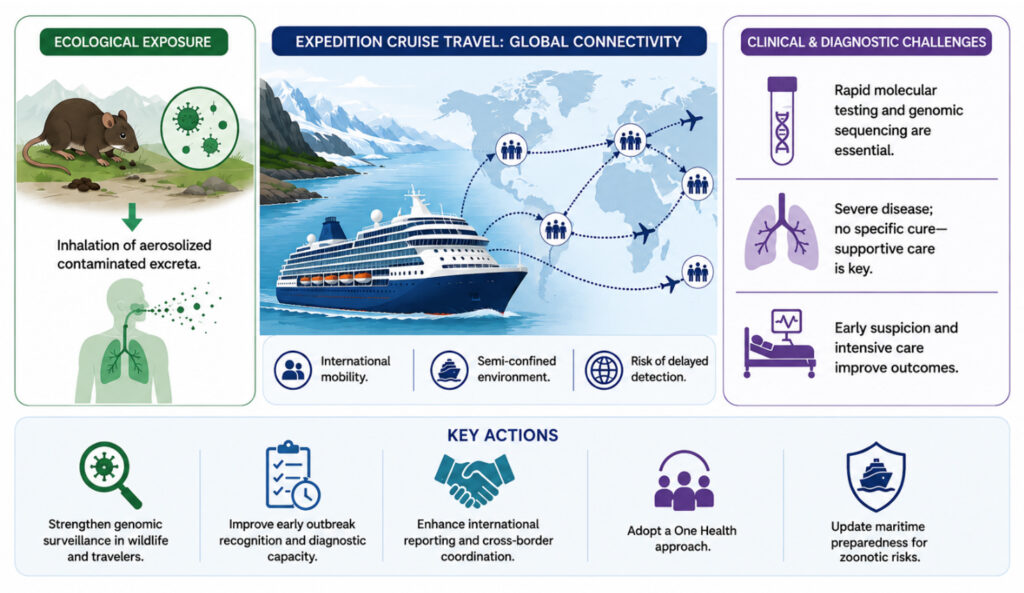
The hantavirus cluster reported in May 2026, associated with expedition cruise travel in the South Atlantic, highlights a rarely examined dimension of maritime infectious-disease preparedness: the movement of international travelers between semi-confined vessels and wildlife-associated settings. This narrative review examines hantavirus infection as a travel-associated zoonotic risk rather than a conventional shipboard outbreak. It summarizes hantavirus microbiology and transmission, with particular attention to rodent-associated environmental exposure, early clinical recognition, and the exceptional concern posed by Andes virus. The review also evaluates how shore landings, wildlife-associated excursions, delayed symptom onset, and post-disembarkation passenger dispersal may complicate exposure reconstruction and public-health response. Molecular diagnostics, genomic investigation, environmental assessment, and One Health surveillance are discussed as key tools for distinguishing shared shore-associated exposure from possible secondary transmission. In conclusion, this review identifies a preparedness gap at the interface of maritime travel, zoonotic ecology, and international surveillance. However, delayed diagnosis, severe disease progression, and geographically dispersed exposure can still complicate early recognition and response.
To cite this article
Hantavirus exposure during expedition cruise travel: emerging challenges in maritime zoonotic preparedness
Infectious Diseases and Tropical Medicine 2026;
12
: e1854
DOI: 10.32113/idtm_202606_1854
Publication History
Submission date: 11 May 2026
Revised on: 18 Jun 2026
Accepted on: 25 Jun 2026
Published online: 03 Jun 2026

This work is licensed under a Creative Commons Attribution-NonCommercial-ShareAlike 4.0 International License.